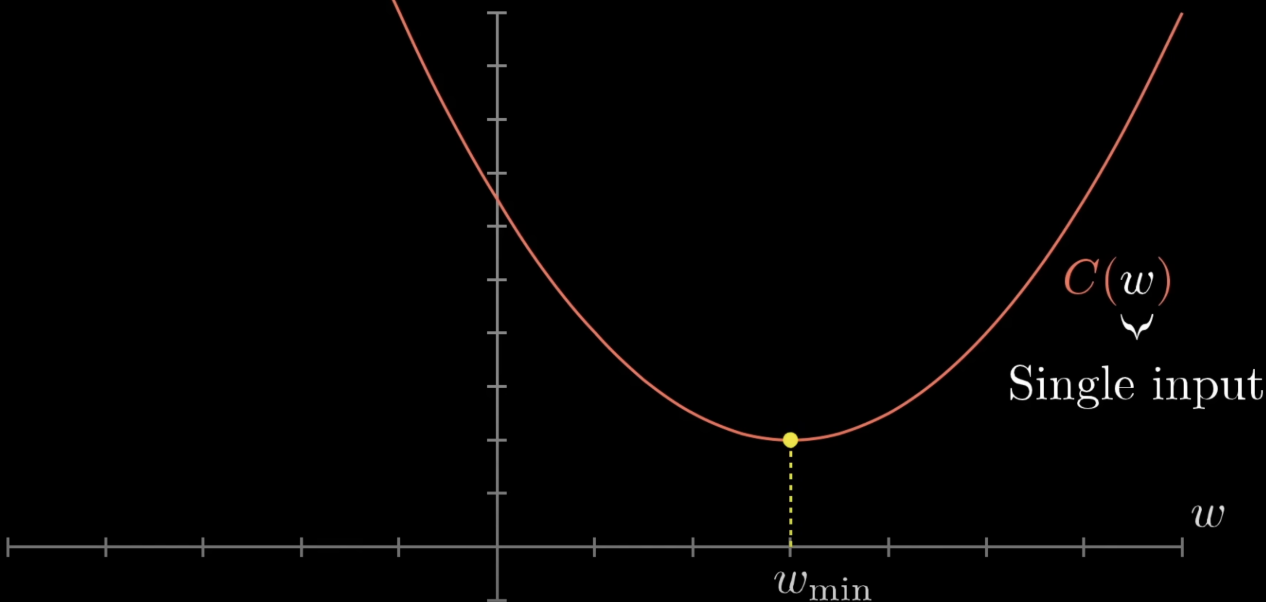
A function is convex if any line segment between two points on its graph lies above (or on) the graph. Convexity is the property that makes optimisation tractable — every local minimum is a global minimum.
Definition
A function is convex if, for all in its domain and :
Geometrically: the chord connecting any two points on the graph never dips below the graph.
 Strict convexity replaces with (for and ), ruling out flat regions.
A concave function is just the negative of a convex one (chord lies below the graph). Maximising a concave function is the same problem as minimising a convex one.
Why Convexity Matters
The key consequence: for a convex function, every local minimum is a global minimum. If gradient descent converges to a critical point (), that point is the global optimum — no worry about being trapped in a worse local minimum.
For strictly convex functions, the global minimum is also unique (no flat plateaus or multiple equally-good optima).
Tests for Convexity
For univariate, twice-differentiable : is convex iff everywhere. Strictly convex iff everywhere.
For multivariate, twice-differentiable : is convex iff its Hessian is positive semi-definite at every point ( for all ). Strictly convex iff is positive definite (strict inequality for ).
Subgradient test (for non-differentiable convex functions): any subgradient — a linear function that touches the graph at a point and lies below it everywhere — exists at every point in the interior of the domain. If is a subgradient at , then is a global minimum.
Examples
| Function | Convex? | Notes |
|---|---|---|
| Yes (strictly) | ||
| Yes (strictly) | ||
| Yes (strictly) on | ||
| Yes | Convex but not differentiable at 0; subgradient exists | |
| Yes (strictly) | Bowl | |
| No | Curvature flips sign |
Convexity in Machine Learning
The optimisation problems we want to solve are convex if both the loss and any regularisers are convex (and combined with non-negative weights). Convex problems include:
- Linear regression with squared error.
- Logistic regression with cross-entropy loss — strictly convex in .
- Support Vector Machines with hinge loss + L2 regularisation.
- Lasso (linear regression + L1 regularisation).
Non-convex problems include neural networks (the network’s output is a non-convex function of its weights), most clustering objectives (K-means is non-convex), and many latent-variable models.
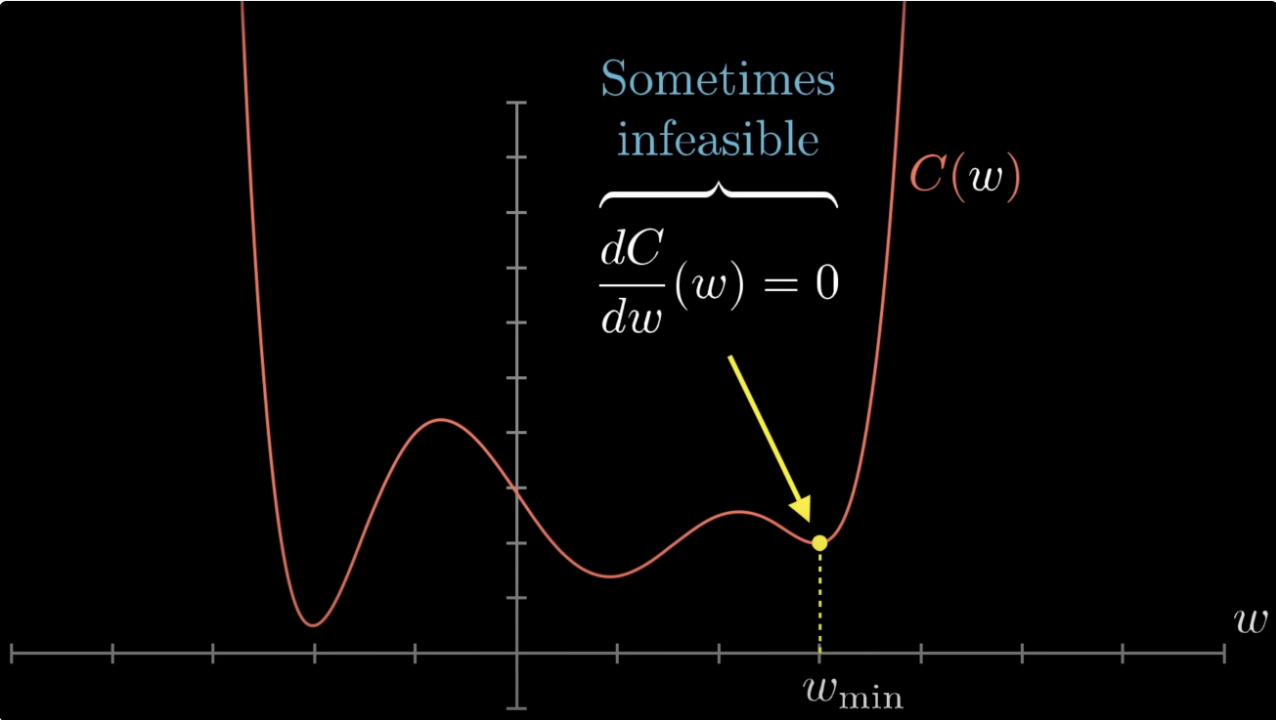
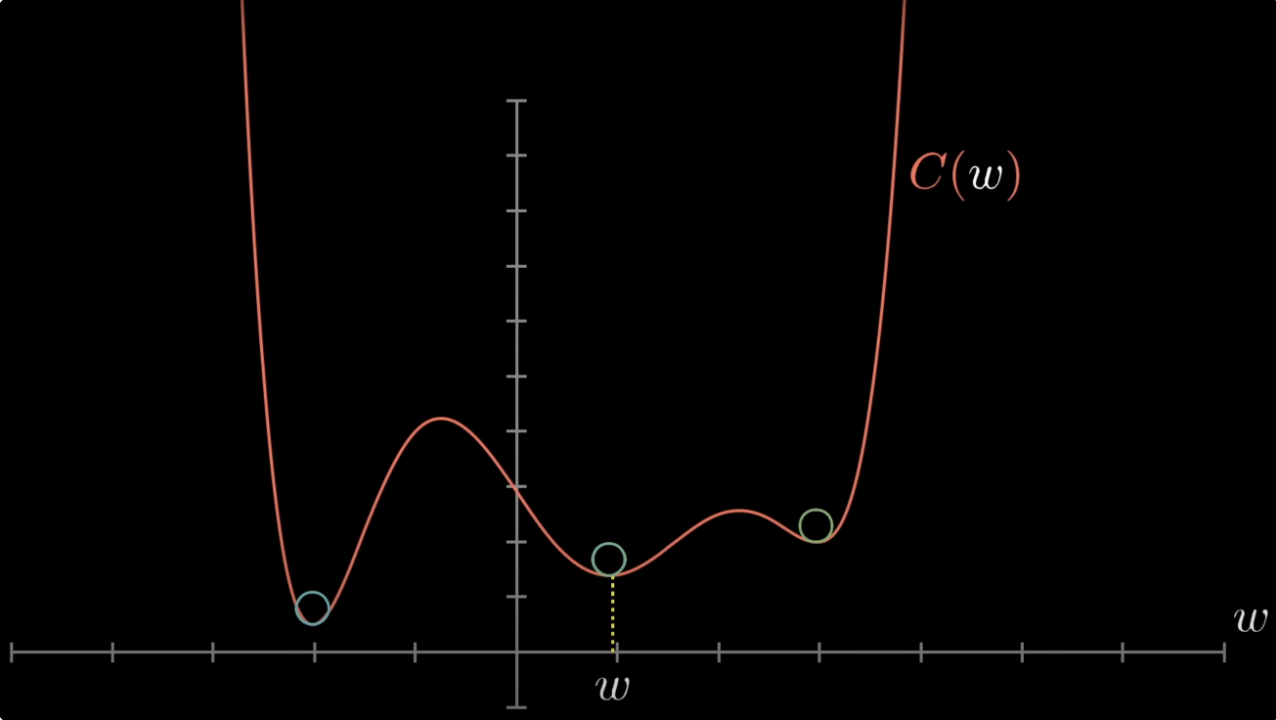
When the problem is convex, gradient descent and Newton-Raphson are guaranteed to find the global optimum (under mild conditions). When it is not, optimisation becomes a heuristic search — gradient descent finds some local minimum, and we hope it’s a good one.
Operations That Preserve Convexity
- Sum of convex functions is convex.
- Maximum of convex functions is convex (e.g., — the ReLU).
- Composition with an affine function: is convex if is.
- Non-negative scaling: is convex for .
These rules let you build complex convex losses from simple convex pieces.
Related
- cross-entropy-loss — strictly convex in , hence has a unique global minimum
- gradient descent — succeeds reliably on convex losses
- newton-raphson-method — guaranteed to descend on (locally) convex regions
- hessian-matrix — positive semi-definite Hessian characterises convexity
Active Recall
Why does convexity make optimisation easy?
For a convex function, every local minimum is a global minimum. So any iterative method that descends (gradient descent, Newton-Raphson) and converges to a critical point is guaranteed to land on the global optimum. There is no risk of getting trapped in a worse local minimum, and no need for expensive techniques like random restarts or simulated annealing.
How can you tell if a twice-differentiable multivariate function is convex?
Check whether its Hessian is positive semi-definite at every point in the domain — i.e., for all and all . For strict convexity, replace with (for ). Equivalently: all eigenvalues of are non-negative (positive for strict convexity).
Is (absolute value) convex? Differentiable? How would gradient-based optimisation handle it?
Yes, it’s convex (the chord between any two points lies above or on the graph). But it’s not differentiable at . Standard gradient descent fails there because there’s no unique gradient. The fix is the subgradient: any line that touches the graph at and lies below it (any slope between and ) qualifies as a subgradient, and subgradient descent uses one to determine the update direction. At , the subgradient exists, signalling that we’re at the global minimum.